
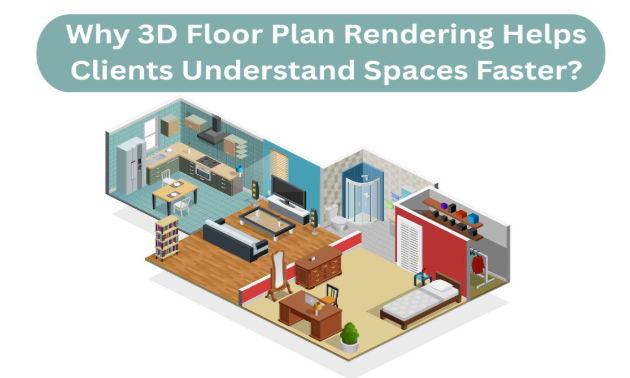

Effective communication is a very important factor when it comes to displaying any architectural or interior design project. However, it often becomes a challenge for some clients who are unable to clearly visualize 2D designs. As a result, they usually end up confused about the size and layout of a room and its relationship with space. It is at this juncture that 3D floor plan rendering becomes an indispensable tool. 3D floor plans allow you to convert 2D designs into 3D designs with furniture and at scale.
Having an experienced 3D architectural visualization company assist architects and developers’ projects will also result in more realistic views with proportionate and authentic textures and lighting, as well as authentic furniture layout. A quicker understanding on the side of the client will then enable better communications.
Below are some reasons for the superior impact created by 3D graphics on floor plans for clients.
1. Transforming Abstract Layouts
Conventional 2D perspective diagrams use symbols, graphics, and scale measurements that are hard for most people to relate to. By contrast, 3D floor plan rendering shows the same information but presents it in a rich and easy-to-understand format.
Clients get to see:
- Room size considerations within a realistic setting
- Furniture arrangement and distance
- circulation paths
- Relationship among various zones
A highly realistic representation eliminates ambiguity and hastens understanding on the client’s side because it becomes very easy for them to relate.
2. Demonstrating How Layout, Function, and Flow are Related
It’s hard to get a sense of what it might be like to be in space with a two-dimensional drawing. 3D floor plans put clients in a position to walk through and get a sense of traffic flow from a top-down perspective.
It aids the client in realizing:
- How rooms are connected
- The efficiency of circulation
- Whether the layout facilitates or hinders their lifestyle or business operation.
- How open or closed the space will be
Based on these insights, it becomes easy for clients to make quick judgments about functionality and provide better feedback.
3. Showing Furnished and Decorated Rooms for Better Visual Clarification
Blank floor plans do not provide an understanding of furniture and space usage. 3D Floor Plan Rendering resolves these issues by incorporating furniture, appliances, texture, and decoration.
It assists clients in understanding:
- Whether the furniture fits nicely
- How much open space will there be
How Interior Design Affects the Environment
Interior design affects:
- Whether there is layout support for desirable activities
- It would make the space look occupied and functional.
A furnished space hastens understanding and decisions among clients.
4. Improving Scale Perception and Eliminating Misinterpretations
Clients who can conceptualize 2-D designs still have scale problems. Bedrooms and living rooms can look too large or too small on paper. 3-D floor plans allow viewing of all features at scale.
It clears up confusion about:
- Ceiling height perception
- Furniture scale
- Pathway Clearance
- Storage space availability
When the scale is proportionate, it becomes easy for the client to perceive spatial relationships without relying on visualization.
5. Facilitating Ease of Comparison for Various Design Choices
When there are multiple layout designs, it becomes confusing for the client to make comparisons by viewing 2D designs. The 3D designs allow easy and clear comparisons.
Clients can compare:
- Room organization
- Space utilization
- Furniture arrangement
- Style and aesthetic considerations
It enhances fast decision-making cycles and fewer revisions, particularly with the expertise and guidance of a professional 3D architectural visualization company.
6. Improving Emotional Engagement with Realistic Presentation
Clients would be more apt to accept a design that they can relate to. 3D floor plan rendering goes beyond functionality and relates to emotions as it allows clients to visualize themselves within the completed project.
This raises user engagement as it enables clients to:
- Develop an understanding of daily life
- Observe how well their life integrates with nature
- Try to picture furniture or things they may have.
- Feel excited and confident about the design
It would result in more rapid approval and even more trust among clients and designers.
7. Improving Communication with Non-technical Stakeholders
Not all decision makers can read architectural designs. It can be common practice for investors, home buyers, and businesspeople to rely on images instead.
3-D floor plans allow easy communication among all parties with:
- Understandable top-down images
- Intuitive understanding of space
- Reduced dependence on technical vocabulary
- Faster alignment among teams
A good visualization tool will make sure that everyone involved agrees on things from the start.
Concluding Remarks
3D floor plan rendering enhances the interpretation and understanding of your clients. You can change 2D designs into 3D designs that have furnishings and scale. It will be easy for your clients to make decisions because their understanding will be better. It will result in faster project completion.
Working with an experienced 3D architectural visualization firm will allow these floor plans not only to be accurate but also aesthetically engaging, thus helping to bridge the gap that sometimes separates design intention and understanding.