
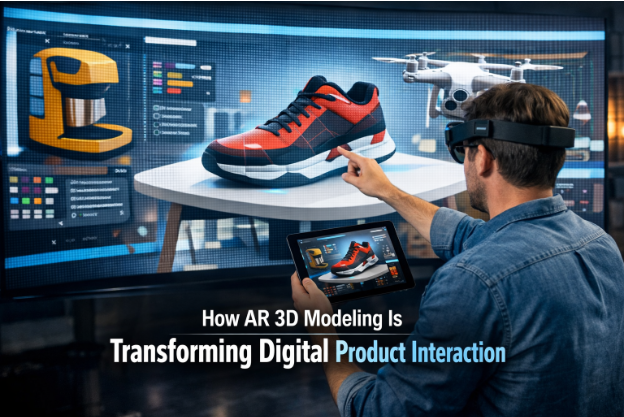

Ranging from increased engagement and dynamism to a much more realistic experience, the interaction with a digital product has literally taken a leap in the past decade or so. Brands are thus attempting to access technologies that make a product as close as possible to a customer without necessarily allowing it to come into contact with it. At the forefront of this new wave, of course, is AR 3D modeling, which combines augmented reality with a highly detailed 3D product that creates a rich experience.
With the help of a professional 3D modeling company, brands can develop very precise Digital Twins of their products. Digital Twins are the cornerstones of realistic AR experiences that make it possible for users to view, investigate, and understand products in a completely novel way. In this way, AR-based experiences increase the stakes of digital commerce, customer engagement, and product education.
Here are some ways augmented reality-based 3D modeling is revolutionizing the paradigm of product interaction in different sectors.
1. Creating a More Intuitive and Immersive Product Discovery Experience
AR 3D modeling revolutionizes as it allows consumers to turn, zoom, and examine products from any angle, as if it were in a physical store.
This creates an intuitive experience that empowers users to:
- Notice texture, finish, and detail
- View hidden components or details of construction
- Understand product shape and structure
- Interaction with object using natural gestures of touching
With a more tangible experience of virtual exploration, users are involved with AR exponentially.
2. Supporting Life-Size Product Visualizations in Real-World Scenarios
Removing the greatest potential hindrance to online sales, which would be a buyer’s unknowns about a product’s integration with their space, this technology places a true-scale model of it right in that space.
- Customers can imagine these scenarios:
- Furniture in their living rooms
- Home décor on real walls
- Kitchens/offices Appliances
- Gadgets on the desktop or counter
These realistic previews, thanks to the models offered by a professional 3D modeling company, help consumers make confident purchasing decisions.
3. Feature and Functionality Demonstration with Interactive AR
Some features are complex, and it would be difficult to communicate them through pictures. With AR, brands can make these features come to life through animation, or users can use their own hands to interact with features of a product.
Examples include:
- Revealing a recliner extending
- Showcases how modular bookshelves rearrange
- Show interior storage compartments
- Description of the Controls on Smart Devices
A major reason for this integration of technology in product demonstrations for consumers is that AR experiences are more interactive. Product demonstrations, when explained in words, were not as easily understandable as when they could see it three dimensionally.
4. Creating an Emotional Connection with Immersive Engagement
Sales are likely to occur as a result of the customer being emotionally attached to the product. AR 3D modeling creates a presence and a sense of excitement for users to experience in their own space.
This is owing to the consequence of:
- Leads to an increase in exploration time
- Drives purchase intent
- Creates creates ownership
- Enhances Brand Recall
The application of AR is usually found in brands that experience a high customer retention rate.
5. Personalization of Customer Experience with Real-Time Customization
Personalization is a key factor in online engagement. With AR, personalization goes a step further since it provides consumers with a direct view of how a 3D version would look.
Customers can make the following modifications:
- Colors and Textures
- Formats or sizes
- Material finishes
- Accessories and add-ons
Such customizations, enabled with support from professional 3D modeling companies, would then emerge with lighting effects, shading, and texture simulation realistic enough for all options to appear real and trustworthy.
6. Reducing Uncertainty and Returns through Detailed Visualization
However, one of the reasons that consumers hesitate in making purchases over the internet is uncertainty. Possibly, this would be among the most promising reasons for individuals to hesitate in purchases – that of product accuracy. Problems of inaccuracy can be diminished drastically by using AR.
This naturally translates to a low rate of misunderstandings and returns.
7. Improved Product Education and User Onboarding
Seeing that AR has numerous uses even before a purchase, it also offers a better understanding of a product even after it has been acquired. Companies make use of models that help guide consumers in using a product, from setting it up to maintaining it.
Examples are:
- Step-by-Step Installation Manuals
- Host interactive tutorials on maintenance
- Feature tours
- Technical support services
This helps in providing a better user experience as well as reducing customer support inquiries.
8. Provides Brands with a Cutting Edge in a Competitive Market
With the rising online competition, brands must think of ways to make themselves distinctive. This is where providing AR experience-based interactions becomes a mark of innovation and customer-centricity.
The AR experience offered by models of a 3D modeling company provides businesses with:
- Increased customer engagement
- Higher Conversion Rates
- Enhanced user experience with digital interactions
- Brand credibility and technology advancements
The result that follows in many cases is a direct realization of this competitive advantage in terms of sales.
Final Thoughts
AR 3D Modeling has been touted as the future of digital product interaction. This technology has been able to make online interactions immersive, realistic, and emotionally resonant with users. Whether it’s intuitive product browsing, in-context installation, usage, and functionality, as well as personalizing the product, consumers have been able to experience a product in ways that were unheard of before.
The accuracy and creativity brought about by professional 3D modeling services will, therefore, be what sets apart good AR experiences, ensuring that all digital assets are of high accuracy and also aesthetically pleasing. With AR set to continue growing in a wide range of industries, companies that invest in this technology are better placed than others in meeting customer expectations in this new era of customer experience.